0:00
–:––

Calibrate Slide Timings

Play the audio, then click Mark Slide the moment the narration moves to each new topic. Timings are saved automatically.

Next:
Waiting to start…
A 5-Minute Explainer

BITCOIN
101

You've heard about it. You're curious.
Maybe a little intimidated.
In a few minutes — it clicks.

Step 1 of 3 — Where the Money Lives

In Bitcoin, the money lives
in addresses

Bitcoin Address (public — like an account number)
1A1zP1eP5QGefi2DMPTfTL5SLmv7DivfNa
Balance
0.724 BTC
🌐
100% Public
Every address and its balance is visible to the entire world, right now. No secrets about balances.
🎭
No Names Attached
Just a long string of characters. No name, no identity — unless you connect it yourself.
🔐
Protected by a Private Key
Anyone can send into your address. But only you can send out — using your wallet and private key.
Step 2 of 3 — Moving Funds

Here's what's actually happening —
right now
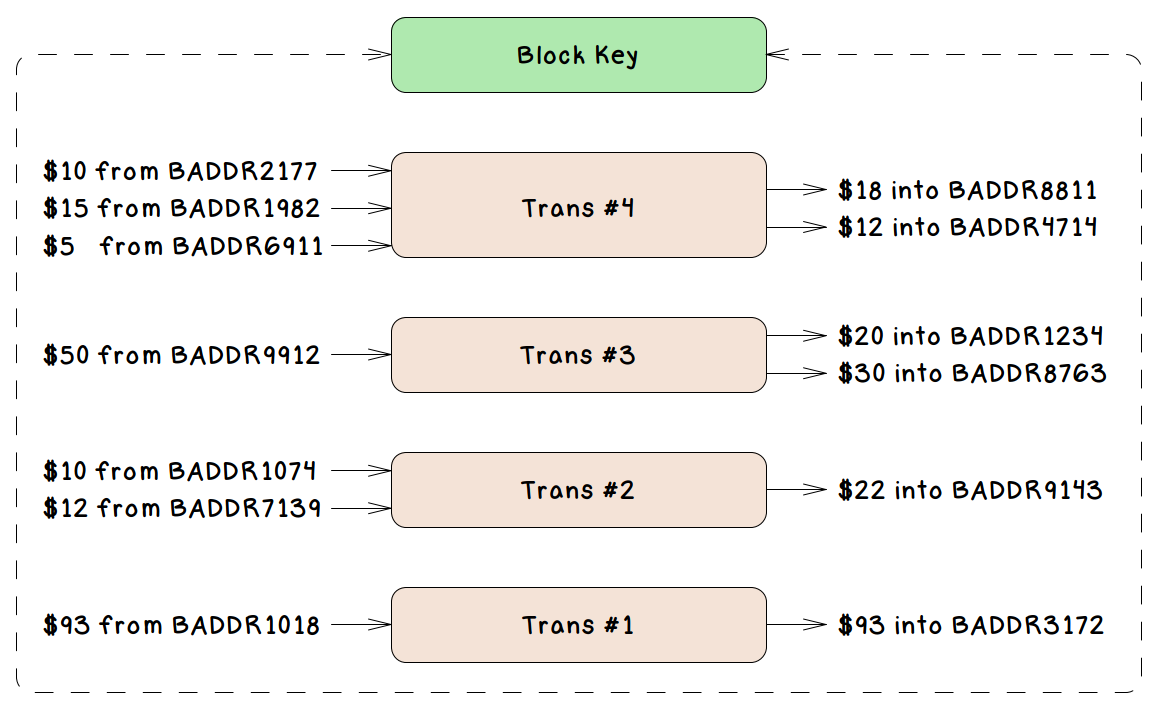
Bitcoin block diagram showing 4 transactions and a Block Key
Transaction #1 — simplest case
$93 from BADDR1018
$93 into BADDR3172
One input, one output. Like writing a check — take from here, deposit there.
Transaction #2 — two inputs combined
$10 from BADDR1074$12 from BADDR7139
$22 into BADDR9143
Pull from multiple addresses at once — like using two gift cards together.
Transaction #4 — multiple in, multiple out
$10 from BADDR2177$15 from BADDR1982$5 from BADDR6911
$18 into BADDR8811$12 into BADDR4714
Three sources, two destinations — all in one transaction.
The Block Key (top of diagram)
This is what the miners race to find — the magic key that ties all these transactions into one verified block. That's next.
Step 3 of 3 — How It Gets Confirmed

Enter the miners.
They make it all real.

Step 1
Gather & Bundle
A miner collects pending transactions and bundles them into a candidate block.
Step 2
Find the Magic Key
They race to find a nonce — a number that, run through the SHA-256 hash function with this block, produces a valid result. Billions of guesses. No shortcuts.
Step 3
Win & Chain It
First miner to crack it broadcasts the solution. The whole network verifies it in milliseconds. Block added to the chain. Forever.
Block Reward
3.125 BTC
Plus small fees per transaction. This is how new Bitcoin is created and miners get paid.
Why “Blockchain”
Block + Block + Block…
Each block's key is built from the one before it. Tamper with one old block and every block after it breaks. History is permanent.
Why So Hard?
Security by design
Making it brutally expensive to fake a block is what makes the ledger trustworthy — no bank or government required.
The Aha Moment

That's it.
You actually get it now.

1
Money lives in addresses
Public and visible to all. No name attached. Protected by your private key.
2
Transactions move funds
Take from one or more inputs, send to one or more outputs. Transparent math.
3
Miners make it official
Bundle transactions into a block, find the nonce, add the block to the chain, earn the reward.
Want to go a little deeper?
  • Balances are in BTC, not dollars — we used $ for simplicity.
  • Every input must be signed by the owner's private key or it's rejected.
  • Miners keep a small fee per transaction — that's why outputs are slightly less than inputs.
  • SHA-256 is a one-way function — you can't reverse it, only guess.
You don't need to know this to use Bitcoin
  • You don't know TCP/IP to use the internet.
  • You don't know combustion engines to drive a car.
  • You don't need to understand mining to use a wallet.
  • But now you do. Most people never will.